Fail to Break
Enter our prediction competition ahead of the Women’s & Men’s Varsity football matches at the Cledara Abbey Stadium on Friday 21 March 2025

Make 3 predictions on the Women’s and Men’s Varsity matches

Win 10star merch if your predictions are correct – or the closest of all entries

Enter here before KO at 16:00, Fri 21 Mar – full T&Cs are on this page
The 10star Summer Intern Program is designed to introduce undergraduate and graduate students to how we apply data science and quantitative modelling within the sports betting industry.
Through this program, interns will have the opportunity to work on real projects, collaborate with experienced professionals, and gain insights into the workings of a constantly evolving and fast paced industry.

Timeframe
- June - September 2025

Location
- Hybrid working, with regular onsite sessions at our offices in Camden, London

Eligibility
- Strong academic performance in a Mathematical discipline
- Experience using a coding language such as R, Python, C#, VBA
- Ability to work independently and in a team environment
- Interested in sports and thinking about them in an analytical way

Application Process (now closed)
- Interested candidates should submit their resume and a cover letter outlining their interest in the internship program to careers@10star.com with the subject line "Summer Intern Program Application"
- Closing date for applications 30 April 2025
- Shortlisted candidates will be contacted for interviews

Benefits
- Professional Development
Work closely with experienced professionals and participate in learning sessions tailored to enhance your skills - Networking Opportunities
Connect with professionals across various departments and build relationships that could benefit your career in the future - Hands-on Experience
Engage in meaningful projects and tasks that contribute to the company's goals - Remuneration
Competitive salary offered for the duration of the internship - Flexibility
Work around your term dates, study requirements and holidays
Tennis has a unique scoring system that rewards players who can capitalise on their chances. While the importance of converting breakpoints is widely understood, the psychological toll of failing to do so is often overlooked.
For players and fans alike, few moments are more infuriating than watching a 0–40 lead on an opponent’s serve slip away, or enduring a marathon return game in which multiple break chances go begging. All too often, these missed opportunities appear to linger. The same player who squandered break points suddenly struggles to hold serve in the very next game.
A recent example came in the 2025 French Open final, when Jannik Sinner held triple match point on Carlos Alcaraz’s serve but failed to convert. He was promptly broken in the following game and went on to lose both the match and the championship. Moments like these beg the question:

A different way to think about break points
A rather arbitrary statistic that many commentators and pundits throw around is break point conversion. It’s a lazy statistic that doesn’t tell the whole story. For instance, a player might hold a poor conversion percentage yet break serve in every return game where break points arise. Conversely, another player could go 0-for-10 on break points, but if all those chances came in a single game, does that really reflect how the match went as a whole?
Quoting conversion rates in isolation can create a distorted picture; one often in contrary to how a match actually unfolded. For that reason, this analysis takes a different approach. Instead of focusing on conversion percentage, we will look at the frequency of games in which break points occur. More specifically, we will focus on games in which break points occur but are successfully saved by the server. For the purpose of this analysis these are referred to as “swing games”. Using data from over 7,000 ATP and WTA main-tour matches, we analyse how players perform in the service game immediately following a “swing game”.
What the data shows
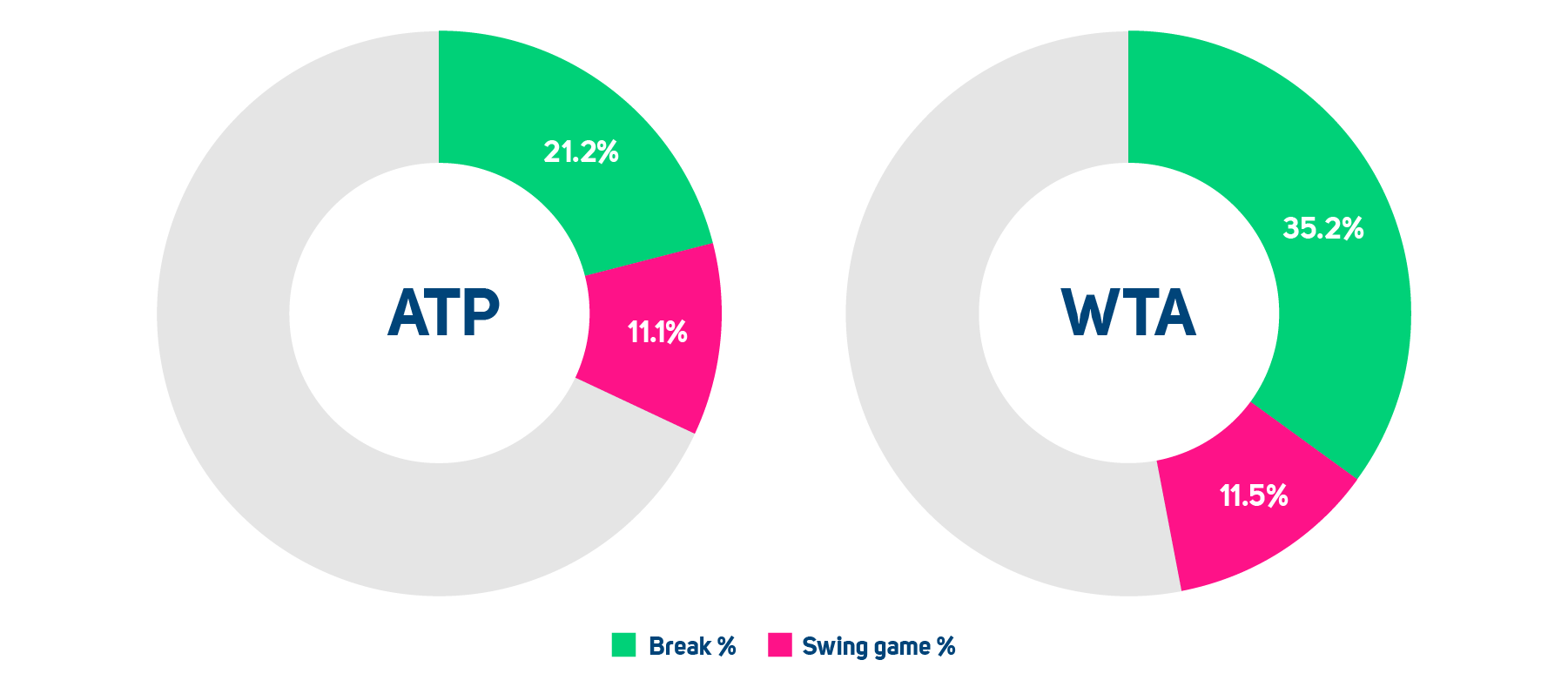
The graph below shows the percentage of swing games that occur in a match on average. These are typically tightly contested games that we often perceive as key turning points. The data suggests that if players were able to convert their break-point opportunities in these games, their overall break rate would increase by an average of 11.1% on the ATP Tour and 11.5% on the WTA Tour. The proportionally greater uplift on the men’s side is largely attributable to serve dominance on the ATP Tour, making break points easier to save.
Missed Breaks
Swing games are therefore clearly important - but do they actually generate meaningful momentum when won, or psychological damage when lost?
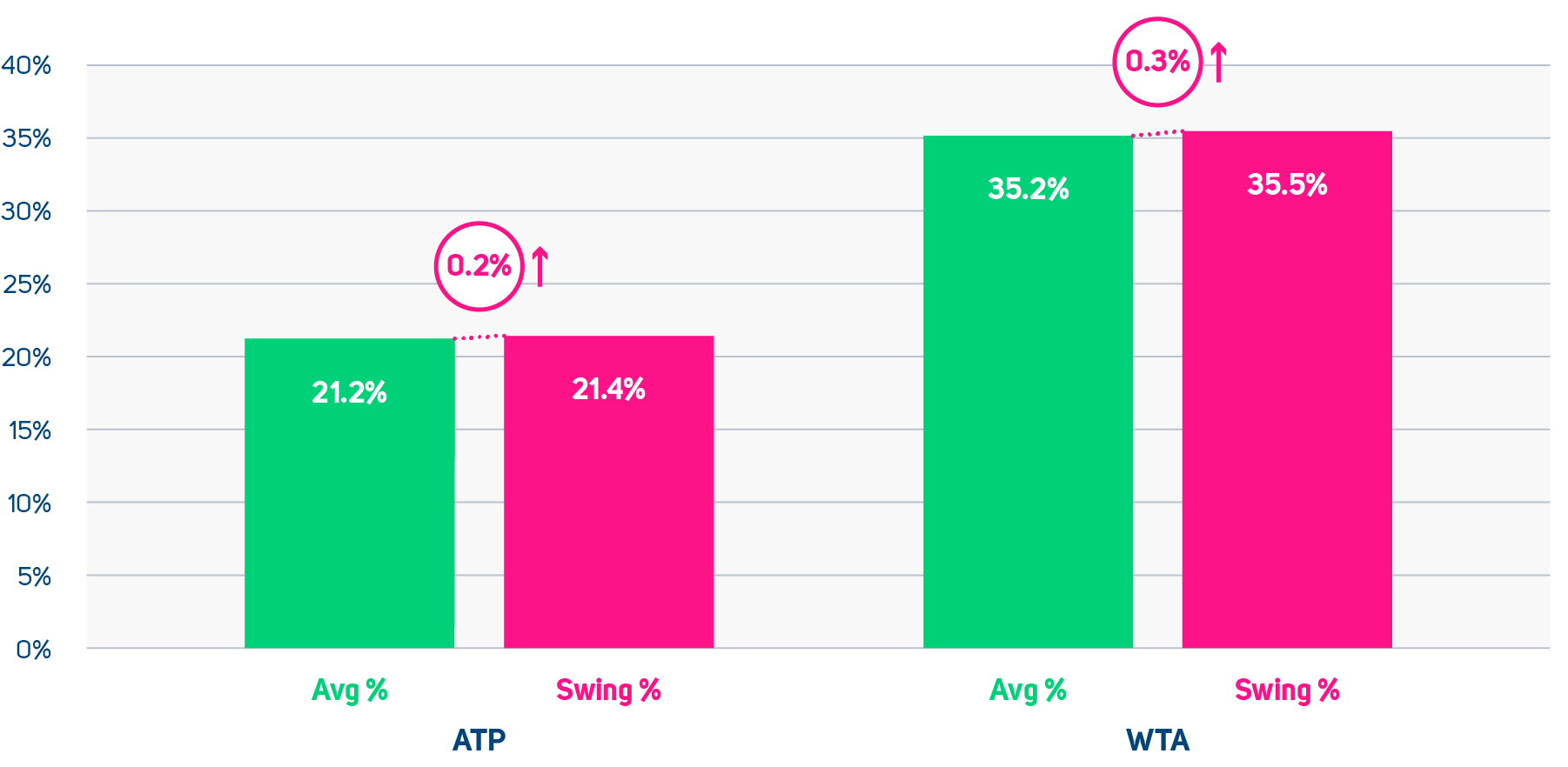
Looking at the ATP data, across roughly 8,000 service games that follow a swing game, the break rate is 21.4%. This represents only a 0.2 percentage-point increase compared to the overall average break rate of 21.2%. A similar pattern emerges on the WTA side where post-swing-game break rates rise only marginally, from 35.2% to 35.5%.
Break %
Using a second lens, we can examine how frequently break points occur in these follow-up games. Here, the break-point rate actually declines. On the ATP Tour, it falls from 32.3% to 31.5%, while on the WTA Tour a similar decrease is observed, from 46.6% to 44.7%.
Break Point %
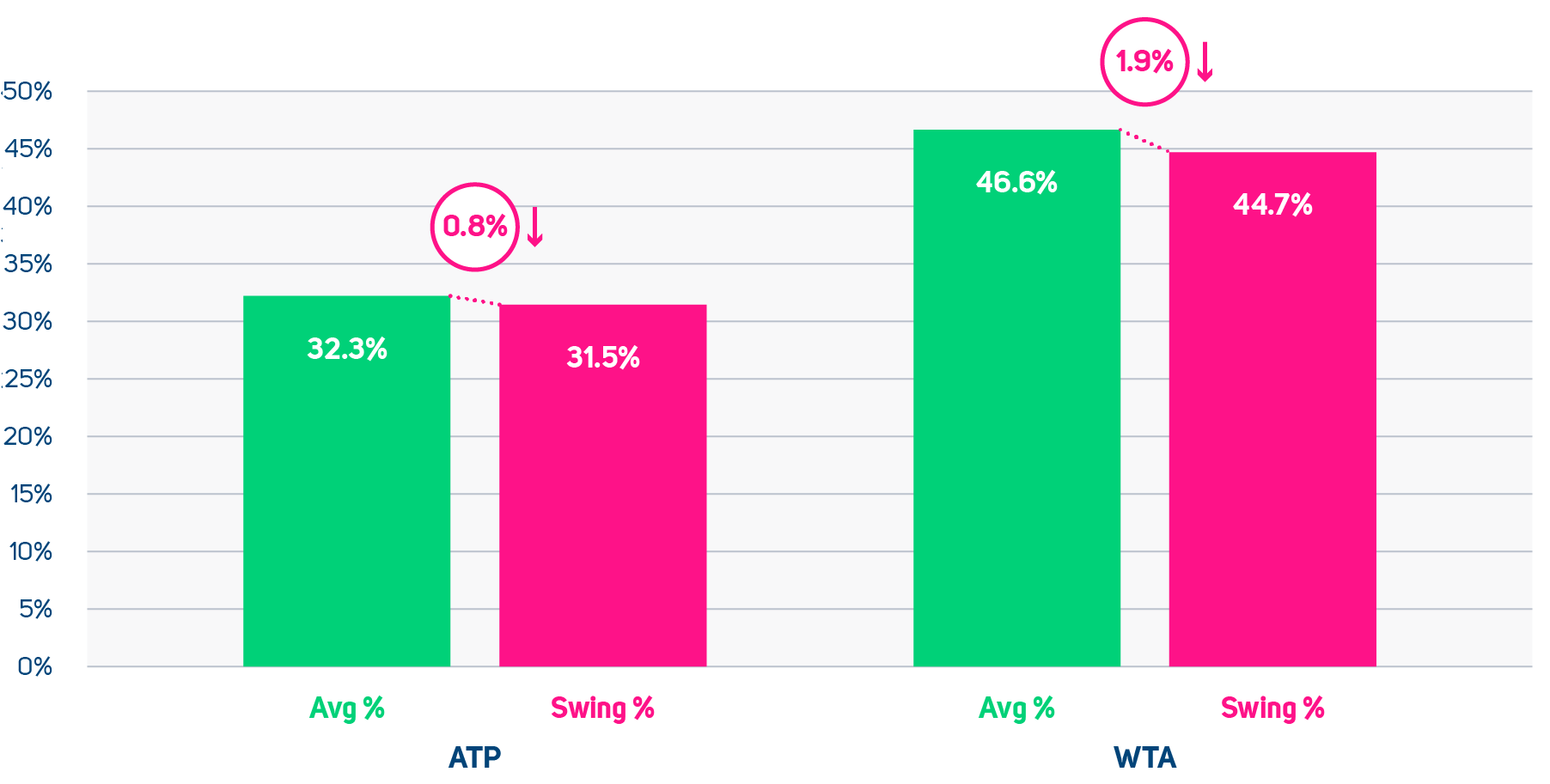
Viewed collectively, both measures point to, at best, a very weak relationship between missing break chances and being broken in the subsequent game.
Final thoughts
Overall, the momentum gained from fending off break points appears far less impactful than intuition might suggest. Likewise, the psychological toll of missed opportunities also appears negligible perhaps in part mitigated by the resilience of modern players, who are able to reset quickly after setbacks. While momentum shifts undoubtedly play a role in shaping matches as a whole, the evidence suggests that simply saving breakpoints does not alter momentum to the extent we might assume.
Interrogating assumptions, stripping away lazy metrics, and modelling what actually matters is the foundation of how we at 10star build pricing and risk systems that respond to the game as it is played, not as it is narrated. This philosophy underpins our Alpha and Neural solutions, enabling operators to eliminate blind risk, sharpen margins, and use their data to support informed decision-making in the toughest trading environments.
Published 18 February 2026
For all enquiries contact info@10star.com