
Scoring and Conceding
Enter our prediction competition ahead of the Women’s & Men’s Varsity football matches at the Cledara Abbey Stadium on Friday 21 March 2025

Make 3 predictions on the Women’s and Men’s Varsity matches

Win 10star merch if your predictions are correct – or the closest of all entries

Enter here before KO at 16:00, Fri 21 Mar – full T&Cs are on this page
The 10star Summer Intern Program is designed to introduce undergraduate and graduate students to how we apply data science and quantitative modelling within the sports betting industry.
Through this program, interns will have the opportunity to work on real projects, collaborate with experienced professionals, and gain insights into the workings of a constantly evolving and fast paced industry.

Timeframe
- June - September 2025

Location
- Hybrid working, with regular onsite sessions at our offices in Camden, London

Eligibility
- Strong academic performance in a Mathematical discipline
- Experience using a coding language such as R, Python, C#, VBA
- Ability to work independently and in a team environment
- Interested in sports and thinking about them in an analytical way

Application Process (now closed)
- Interested candidates should submit their resume and a cover letter outlining their interest in the internship program to careers@10star.com with the subject line "Summer Intern Program Application"
- Closing date for applications 30 April 2025
- Shortlisted candidates will be contacted for interviews

Benefits
- Professional Development
Work closely with experienced professionals and participate in learning sessions tailored to enhance your skills - Networking Opportunities
Connect with professionals across various departments and build relationships that could benefit your career in the future - Hands-on Experience
Engage in meaningful projects and tasks that contribute to the company's goals - Remuneration
Competitive salary offered for the duration of the internship - Flexibility
Work around your term dates, study requirements and holidays
Are teams most vulnerable when they have just scored?
In 2024-25 Leicester scored at Crystal Palace in the 46th minute then conceded in the 47th, Bournemouth scored at Brentford in the 49th minute then conceded in the 50th, Manchester City scored at Arsenal in the 55th minute then conceded in the 56th and Tottenham scored at Wolves in the 85th minute then conceded in the 86th.
Those were only four of 55 instances in the Premier League of a team scoring in one minute and conceding within the next five minutes. There were 52 in the Bundesliga, 46 in La Liga and Ligue 1, 36 in Serie A.
On how many occasions did a commentator say: “A team are most vulnerable when they have just scored”? It is a football cliché. But is it true? Are teams more likely to concede at such times? We will present our own findings but first let us tell you about some others who have considered the question.
Early research
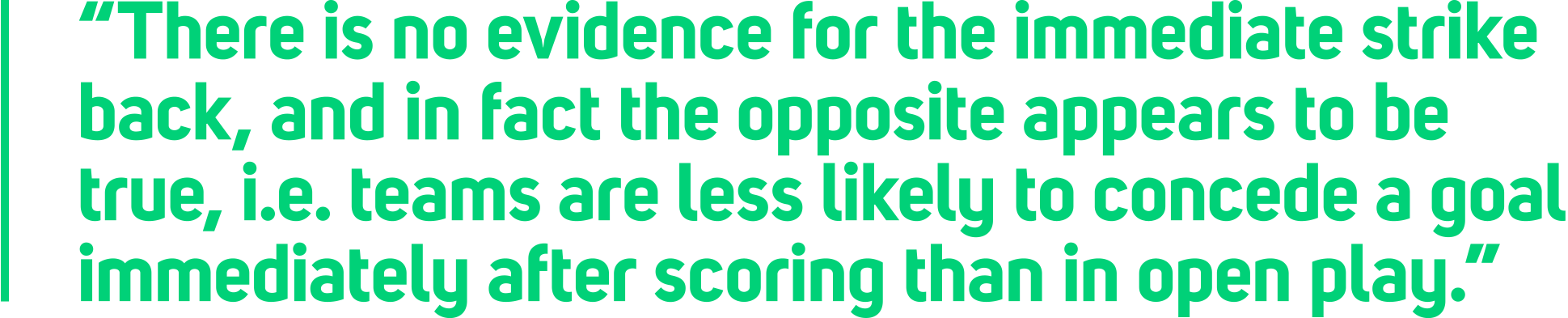
In a 1998 paper called A Birth Process Model for Association Football Matches, Mark Dixon and Michael Robinson investigated the “immediate strike back”. They studied 4,012 English league and cup games between 1993 and 1996 and concluded:
In a later magazine article, though, three psychologists were convinced that teams are more likely to concede just after scoring – and that they knew why. They said:
“I think it’s inevitable that teams relax mentally and lose concentration when they scored an important goal while the other team is still stung by it.”
“If you celebrate too much you will burn off all the extra energy the boost of the goal has given you. By the time you face the kick-off you might feel completely drained when the other team restarts.”
“The fact that the scoring team is huddled together gives the opposing team the chance to make eye contact and harden their resolve. And if the celebrations are too over the top it is likely to put fire in their bellies.”
Those quotes were reproduced by two other psychologists, Peter Ayton and Anna Braennberg, in a chapter of a 2008 book called Myths and Facts about Football. They had studied 127 games ending 1-1 in the Premier League seasons 1994-95 and 1995-96 and concluded: “We have been unable to find any evidence for teams being more vulnerable after scoring.” Their data also suggested that conceding soon was actually less likely than conceding later. But they cautioned: “More sensitive analyses could reveal evidence for some of the effects we have been attempting to find.” Is there?
Our findings
We analysed all 36,266 games played in 20 completed seasons in the Big Five leagues. Those were seasons 2005-06 to 2024-25 in the Premier League, La Liga, Bundesliga, Serie A and Ligue 1.
Our approach differed from that of Ayton and Braennberg, whose approach differed from that of Dixon and Robinson. We are not aware of anyone who has used our approach.
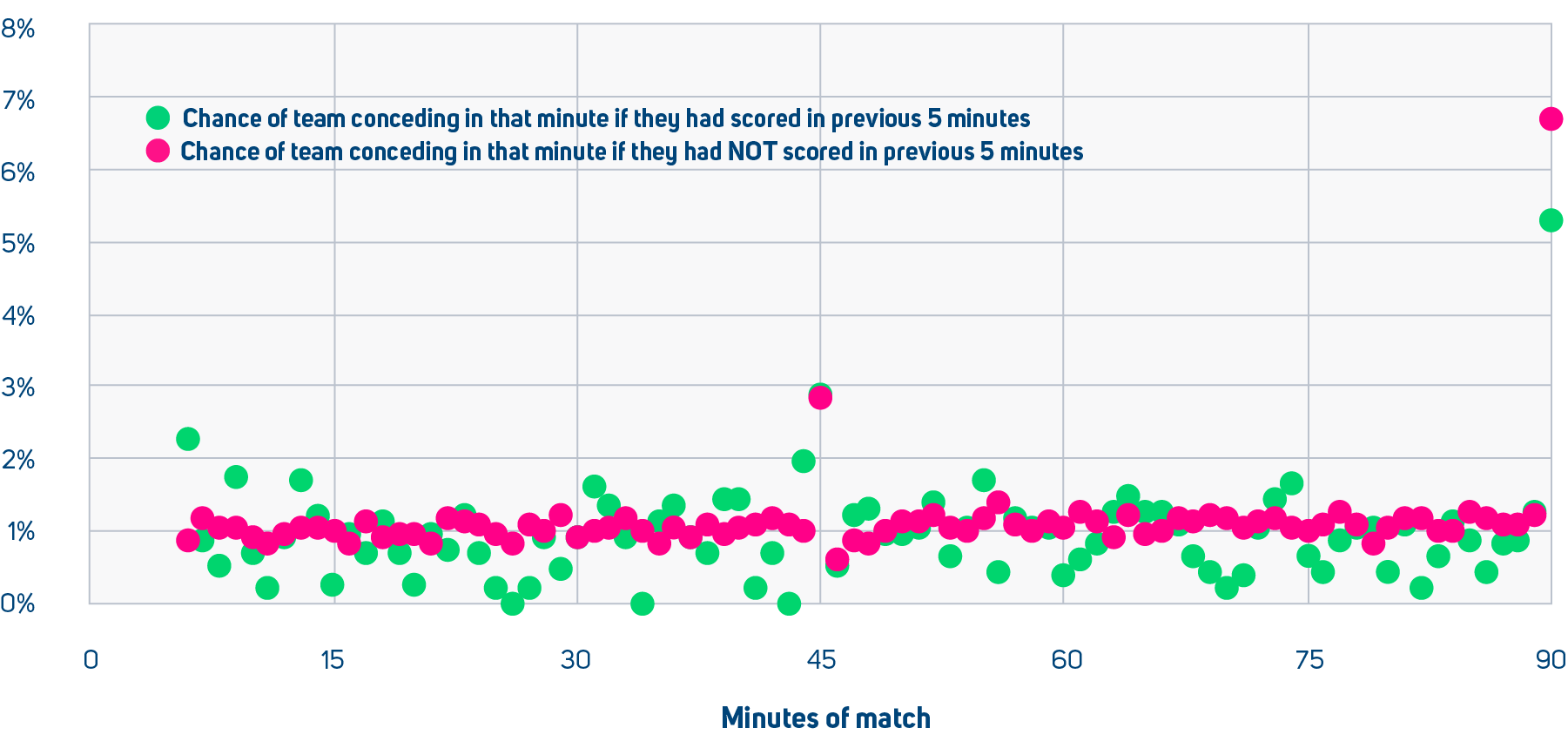
The cliché says that a team are more likely to concede if they have just scored than if they have not. So we asked two questions, for each minute of a match. What was the chance of a team conceding in that minute if they had scored in the previous five minutes? And what was the chance of a team conceding in that minute if they had not scored in the previous five minutes?
This is what we found for 1-1 draws, the games investigated by Ayton and Braennberg. On the graph below the green dots are for teams who had scored in the previous five minutes and the pink dots are for teams who had not scored in the previous five minutes. If teams really are more vulnerable when they have just put the ball in the net, all or most of the green dots should be higher than the pink dots. They are not. Most of the green dots are lower than the pink dots. As you can see…
1-1 Draws, Big Five Leagues 2005/06-2024/25
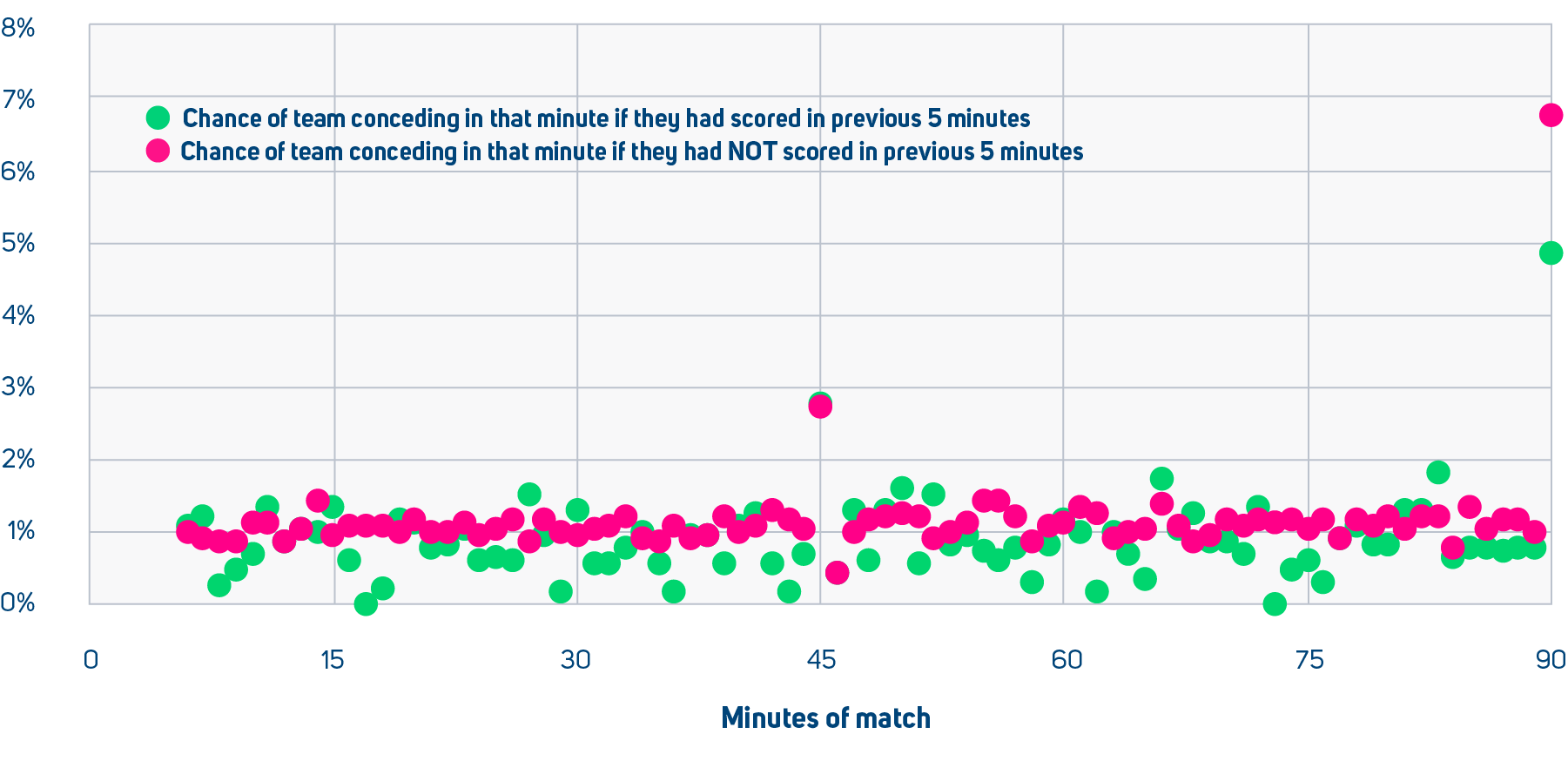
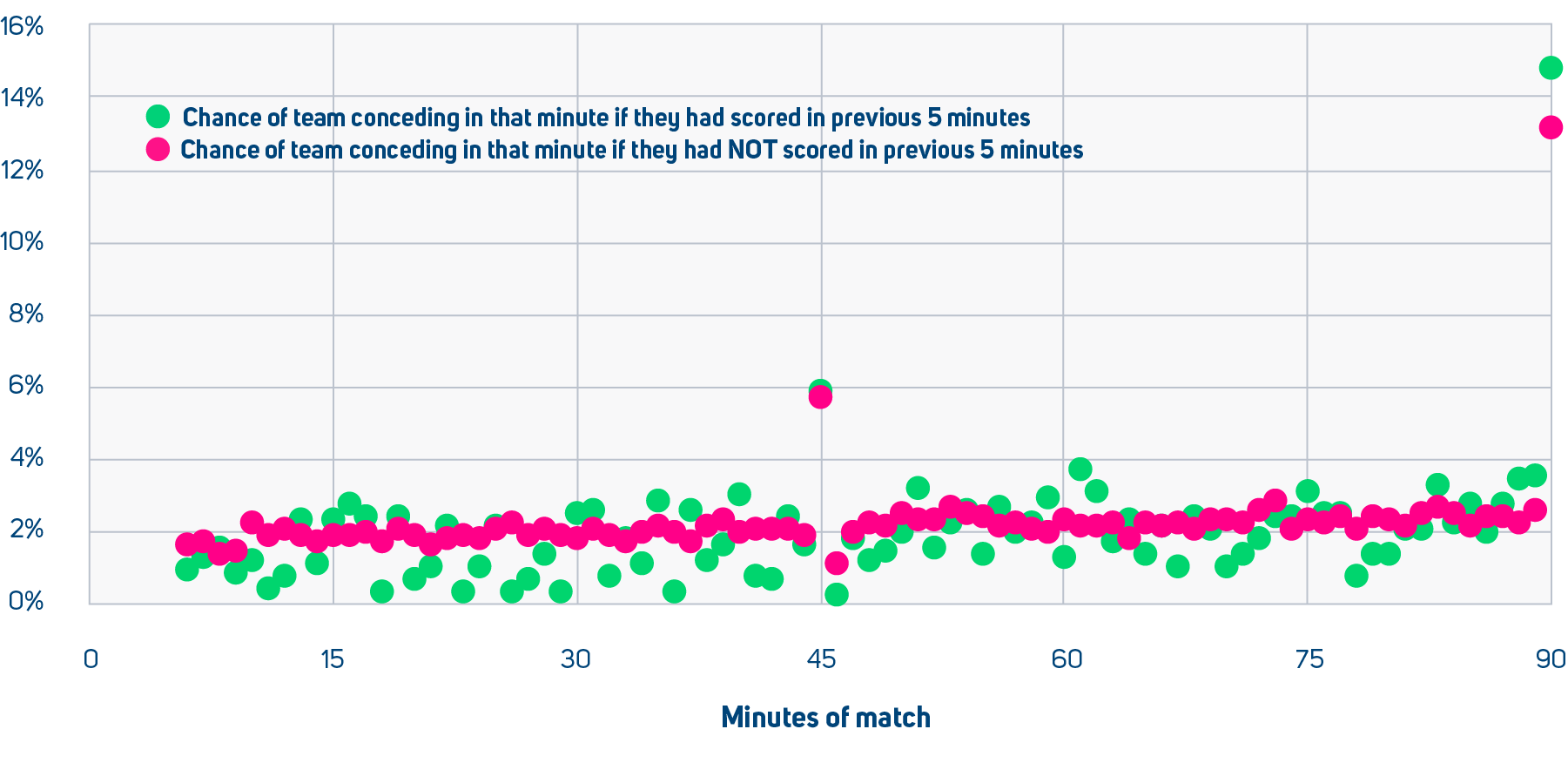
We found the same thing for other scores. Let us give a couple more examples – for teams who won 2-1 and teams who lost 1-2. Here are those graphs…
2-1 Wins, Big Five Leagues 2005/06-2024/25
1-2 Losses, Big Five Leagues 2005/06-2024/25
Confirmation
What we found for all teams with a specific score we also found for specific teams across all scores. We will give an illustration for various finishing positions in a table. And we will do it with another data set: the 32,014 games played in completed seasons between 2005-06 and 2024-25 in the three divisions of the EFL – Championship, League One and League Two (we did not count the Covid-shortened 2019-20 seasons of League One and League Two as completed).
There were different numbers of teams in the leagues of the Big Five, but always the same number of teams in the divisions of the EFL. We divided those into quarters – finishing positions 1 to 6, followed by 7 to 12, then 13 to 18 and finally 19 to 24.
On the graph below we give figures covering the whole of all games…
All games EFL 2005/06-2024/25
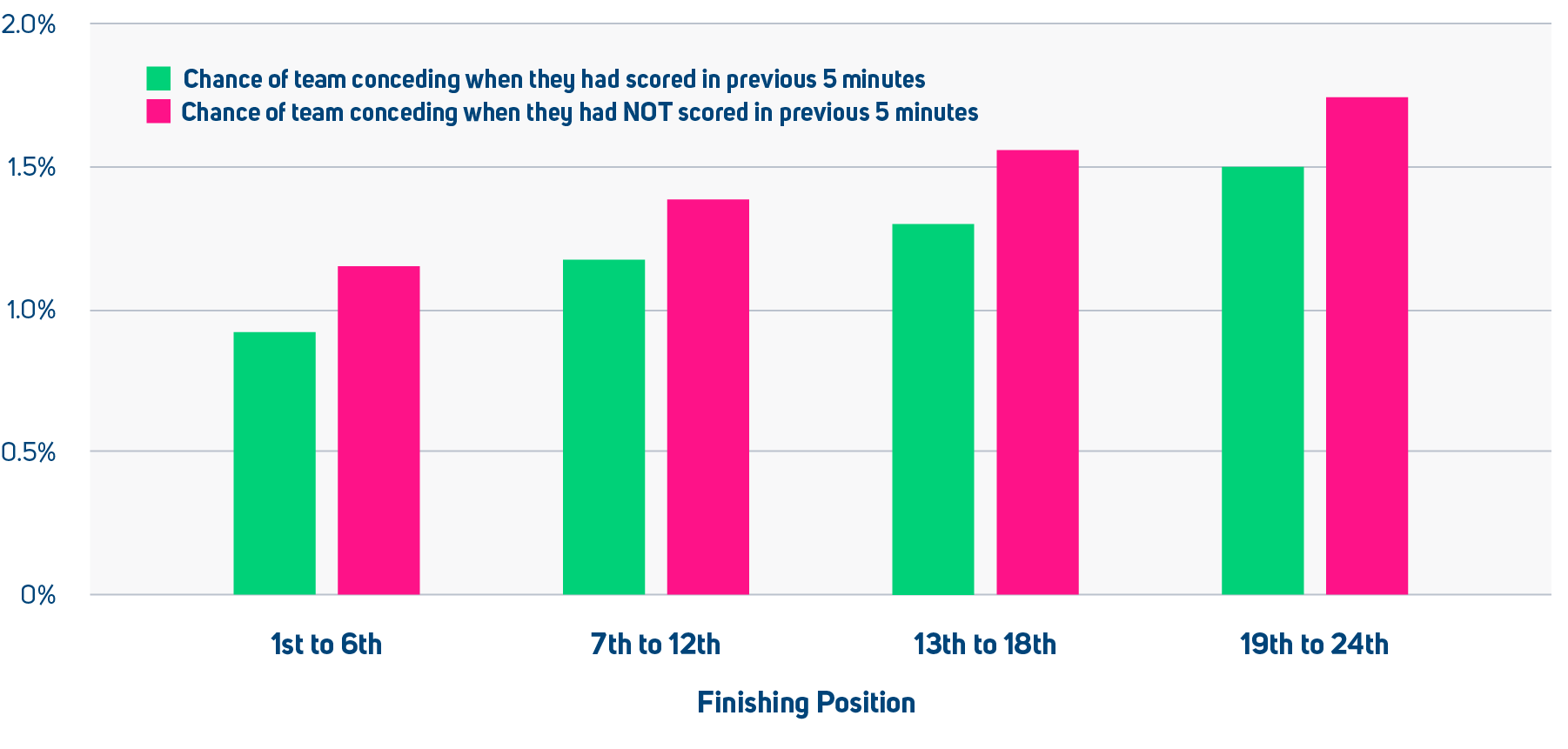
As you would expect, teams who finished in the top quarter conceded less often than teams who finished in the second quarter, who conceded less often than teams who finished in the third quarter, who conceded less often than teams who finished in the bottom quarter. But each group of teams had this much in common: they were a little bit less likely to concede when they had just scored than when they had not.
So why do many believe the opposite? People tend to remember the times when something happened and forget the times when it has not. As Rolf Dobelli wrote in his book The Art of Thinking Clearly:

We found no evidence anywhere to justify the belief that the ball is more likely to go in one goal if it has recently gone in the other. For the record, we found no evidence that it is more likely to go in the same goal either – that is to say, no evidence that a team tend to score again when they have just scored, though of course there have been examples of a team scoring twice in quick succession, perhaps most famously in the 1999 European Cup final.
Implications for sportsbooks
Because we have investigated clichés, and also possibilities that are not clichés, our 10star football model responds to all of the things it should but none of the things it should not. Our partners are receiving prices that always position them optimally in the market, allowing them to reopen markets swiftly and with confidence after a goal, ahead of the competition. This ability to drive turnover and consistently improve the quality of pricing is what generates alpha returns and ensures our partners can always trade with confidence.
Published 02 December 2025
For all enquiries contact info@10star.com