Africa Cup of Nations
Enter our prediction competition ahead of the Women’s & Men’s Varsity football matches at the Cledara Abbey Stadium on Friday 21 March 2025

Make 3 predictions on the Women’s and Men’s Varsity matches

Win 10star merch if your predictions are correct – or the closest of all entries

Enter here before KO at 16:00, Fri 21 Mar – full T&Cs are on this page
The 10star Summer Intern Program is designed to introduce undergraduate and graduate students to how we apply data science and quantitative modelling within the sports betting industry.
Through this program, interns will have the opportunity to work on real projects, collaborate with experienced professionals, and gain insights into the workings of a constantly evolving and fast paced industry.

Timeframe
- June - September 2025

Location
- Hybrid working, with regular onsite sessions at our offices in Camden, London

Eligibility
- Strong academic performance in a Mathematical discipline
- Experience using a coding language such as R, Python, C#, VBA
- Ability to work independently and in a team environment
- Interested in sports and thinking about them in an analytical way

Application Process (now closed)
- Interested candidates should submit their resume and a cover letter outlining their interest in the internship program to careers@10star.com with the subject line "Summer Intern Program Application"
- Closing date for applications 30 April 2025
- Shortlisted candidates will be contacted for interviews

Benefits
- Professional Development
Work closely with experienced professionals and participate in learning sessions tailored to enhance your skills - Networking Opportunities
Connect with professionals across various departments and build relationships that could benefit your career in the future - Hands-on Experience
Engage in meaningful projects and tasks that contribute to the company's goals - Remuneration
Competitive salary offered for the duration of the internship - Flexibility
Work around your term dates, study requirements and holidays
Ivory Coast are the reigning champions of Africa. They are fourth on the all-time Africa Cup of Nations list for games won and joint-fourth for titles won. They are usually at least one of the stronger teams in Africa.
Oddly, though, their record in individual matches was worse when they lifted the trophy than when they were knocked out in the quarter-finals or round of 16.
International tournaments can be weird as well as wonderful. You will read plenty elsewhere about the wonderful. Here we will concentrate on some of the weirdness. There is more of it than you might think. We will illustrate it from the experiences over the years of Ivory Coast. What do those reveal about who might be victorious at the 35th edition of the Africa Cup Nations in Morocco between 21 December 2025 and 18 January 2026?
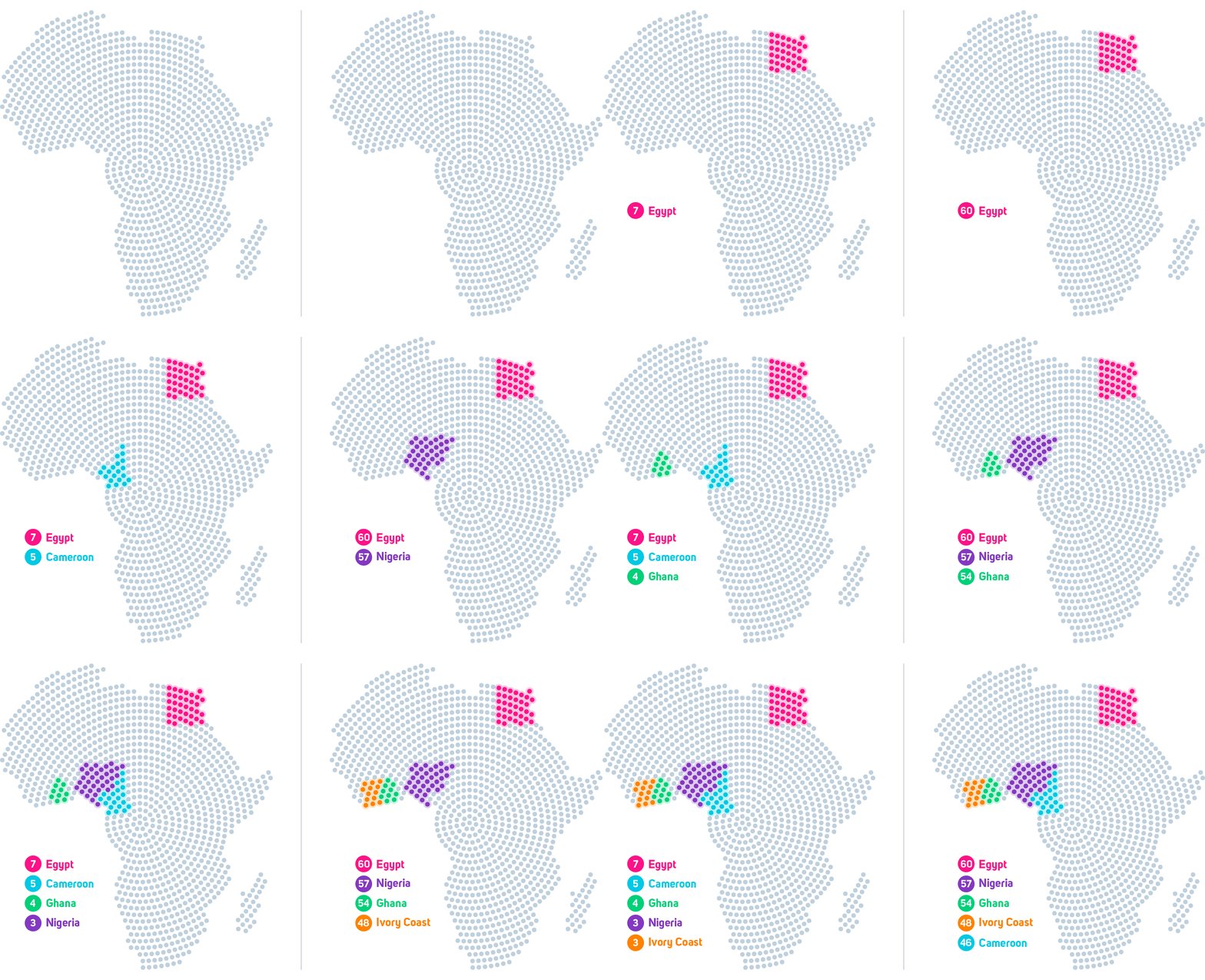
All-time titles won / All-time games won (top five)
The ABC games
In 1986 in the group stage Senegal beat Egypt then Egypt beat Ivory Coast. What happened in the final round of fixtures when Ivory Coast played Senegal? Logic says Senegal won. Logic in football will only take you so far. Ivory Coast won 1-0 and, by a single goal, qualified instead of Senegal.
Why? 32% of group games have been drawn. Therefore in each fixture there would be a 32% chance of a draw, a 34% chance of a win for this team and a 34% chance of a win for that team. The chance of A beating B then B beating C then C beating A would be 34% x 34% x 34%, which is just under 4%.
And in how many three-game sequences did it happen? Just over 2% – somewhere between the theoretical extremes.
A beat B beat C beat A, Africa Cup of Nations Groups, 1968 - 2023

How often has it happened in three-game sequences in other competitions? Just over 2% at the European Championship, and just over 2% at the World Cup.
Results are determined partly by luck and partly by skill. And the skill a team display in one game, or in a small number of games, may not be typical of what they would display over a large number of games. This is why results at the start of a group can be contradicted by results at the end, and why results across the whole of all groups still give only a hazy guide to results in the knockout rounds.
Before moving on we should acknowledge that the earliest research into three-game sequences in groups was published in 2009 in the Journal of Applied Statistics by Gerald Skinner and Guy Freeman.
From group points to knockout position
What generally is the relationship between how well a team did in the group stage and how far they will go in the knockout stage?
We examined 24-team continental championships – the Africa Cup of Nations for 2019, 2021 and 2023, the Asian Cup for 2019 and 2023 and the European Championship for 2016, 2020 and 2024.
Teams qualified from their groups with as few as three and as many as nine points. For the knockouts we allocated a position according to progress. We said the winners were first, runners-up second, beaten semi-finalists third and fourth if there was a playoff, or both 3.5 if there was not. Teams knocked out in the quarter-finals could be said to have finished anywhere between fifth and eighth so we gave them all the average of those positions, which is 6.5. And teams knocked out in the round of 16 could be said to have finished anywhere between ninth and sixteenth so we gave them all the average of those positions, which is 12.5. Note that here low numbers are better than high numbers.
On the graph below we have plotted group points against knockout position.
Group points and knockout position, 24-team editions of Africa Cup of Nations, Asian Cup and European Championship
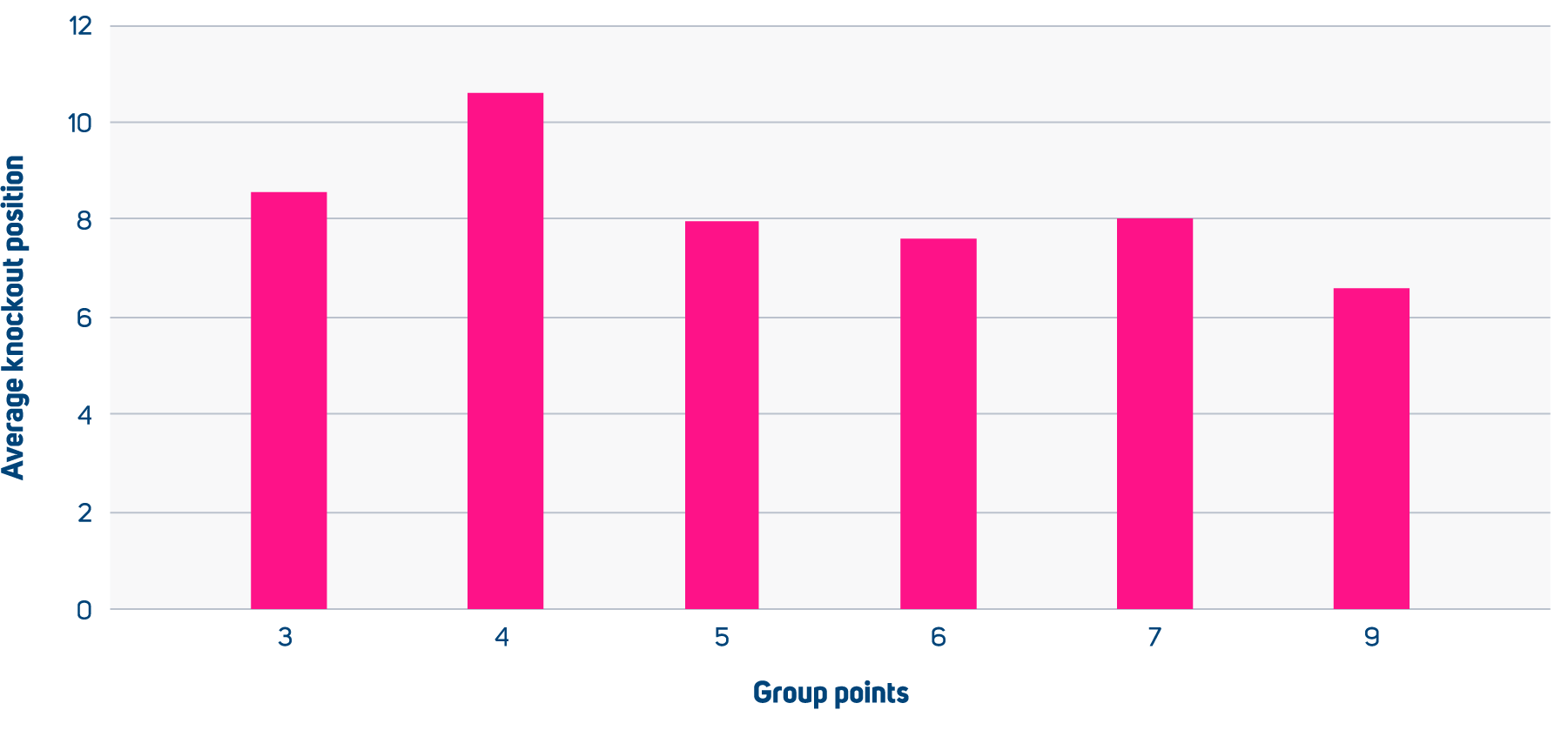
Teams who had qualified with three or four points did less well in the knockouts than teams who had qualified with five, six or seven points, who did less well than teams who had qualified with nine points. But the differences were small. Smaller, we suspect, than many would have anticipated.

Serial shootout successes
In 1992 Ivory Coast won on penalties in the semi-final and final. In 2006 they triumphed in the quarter-final but failed in the final.
When a team win a shootout they are praised. We might be told that the kickers kept their nerve, or that the keeper outwitted opponents. If this were true, teams who have already won a shootout in a tournament should be more likely to win another. It would mean in some way that should be reproducible they had shown they are good at shootouts. How often does it happen?
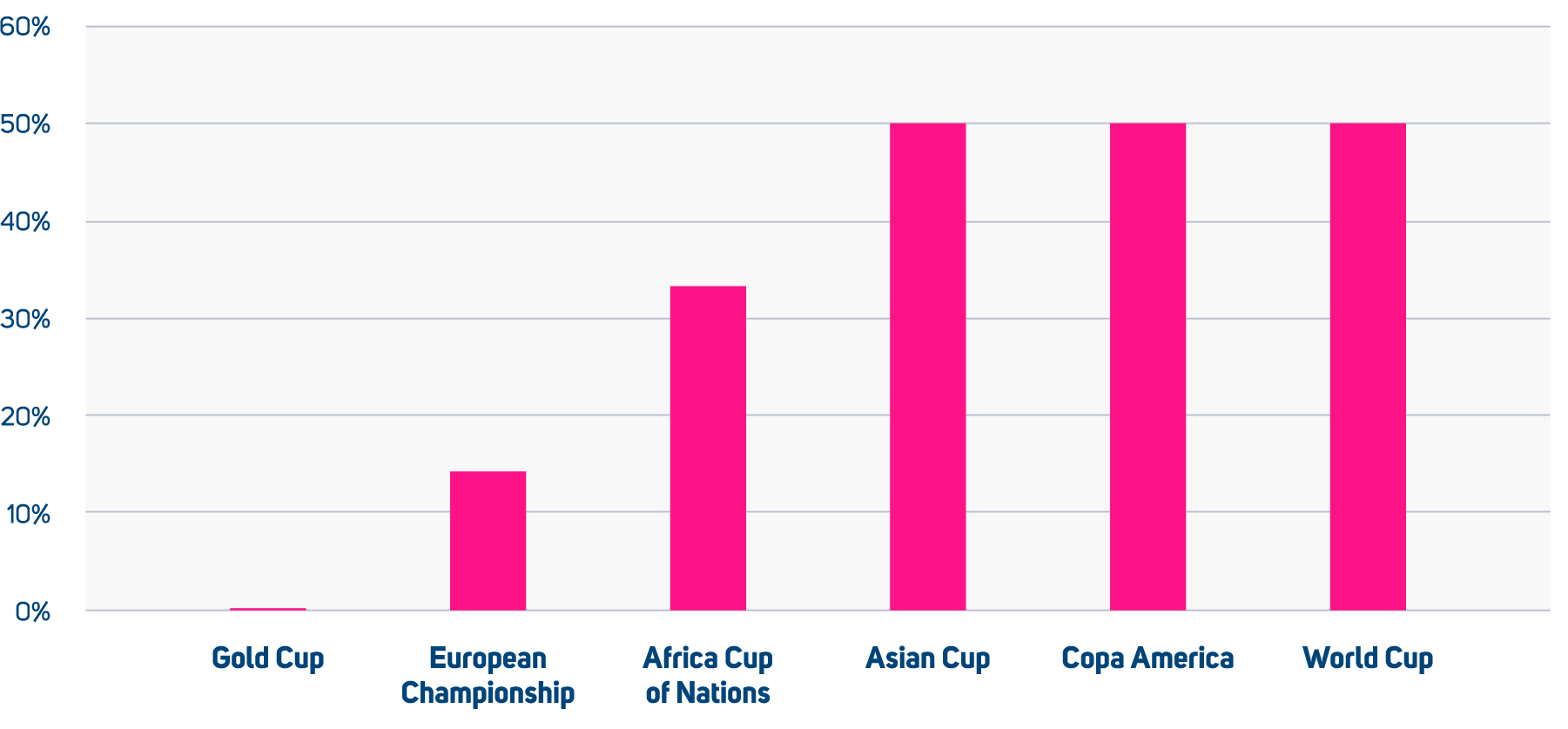
We investigated every incidence of a team being involved in multiple shootouts at the World Cup or a major continental competition – Africa Cup of Nations, Asian Cup, Copa America (for South America), European Championship and Gold Cup (for North and Central America plus the Caribbean). Overall the success-rate in repeat shootouts was 33%. In no competition was it higher than 50% – what it should be if in every shootout each team were as likely to win as the other.
Repeat penalty shootout wins
Conclusion
So what have we learned? Many of the reasonable-sounding deductions that most people make during a tournament are, by varying degrees, unreliable. A sportsbook will see money for them, and for other things as well. How can they know when money for a seemingly logical proposition is misguided, or when money for a seemingly illogical proposition is wise? The answer is by using our customer smartness algorithms which inform in real time whether and to what extent a bettor is shrewd. At the appropriate moments our partners will support or oppose Ivory Coast.
Published 12 December 2025
For all enquiries contact info@10star.com