What influences matches on world football's biggest stage?
Enter our prediction competition ahead of the Women’s & Men’s Varsity football matches at the Cledara Abbey Stadium on Friday 21 March 2025

Make 3 predictions on the Women’s and Men’s Varsity matches

Win 10star merch if your predictions are correct – or the closest of all entries

Enter here before KO at 16:00, Fri 21 Mar – full T&Cs are on this page
The 10star Summer Intern Program is designed to introduce undergraduate and graduate students to how we apply data science and quantitative modelling within the sports betting industry.
Through this program, interns will have the opportunity to work on real projects, collaborate with experienced professionals, and gain insights into the workings of a constantly evolving and fast paced industry.

Timeframe
- June - September 2025

Location
- Hybrid working, with regular onsite sessions at our offices in Camden, London

Eligibility
- Strong academic performance in a Mathematical discipline
- Experience using a coding language such as R, Python, C#, VBA
- Ability to work independently and in a team environment
- Interested in sports and thinking about them in an analytical way

Application Process (now closed)
- Interested candidates should submit their resume and a cover letter outlining their interest in the internship program to careers@10star.com with the subject line "Summer Intern Program Application"
- Closing date for applications 30 April 2025
- Shortlisted candidates will be contacted for interviews

Benefits
- Professional Development
Work closely with experienced professionals and participate in learning sessions tailored to enhance your skills - Networking Opportunities
Connect with professionals across various departments and build relationships that could benefit your career in the future - Hands-on Experience
Engage in meaningful projects and tasks that contribute to the company's goals - Remuneration
Competitive salary offered for the duration of the internship - Flexibility
Work around your term dates, study requirements and holidays
It is 60 years since England won international football's top competition. It is nearly 30 years since Scotland even qualified. Both will be in action in the tournament that takes place between 11 June and 19 July.
How will they get on? And others too? This will be the biggest four-yearly festival of football yet.
What influences matches at a WC? Why do teams win, draw or lose, when are ties decided, how are the players controlled by the referees, and what sort of countries become champions? Some things matter and other things do not. It is worth knowing which are which. Here are a few of each…
Qualifiers are a bad guide to tournaments
England qualified for this WC with a perfect record: eight games, eight wins. What does that tell us about how they will do in the United States, Canada and Mexico? Almost nothing. There is little if any correspondence between results in qualifiers and at a tournament.
We compared them for the last seven WCs: 1998 to 2022.
We ranked European qualifiers by their record in their qualifying groups. The team with most points per game were first, the team with fewest points per game were last. If they tied on points per game we separated them on goal difference per game.
Until 2014 the FIFA technical reports ranked countries at a WC. The winners were first, the runners-up second and the country with the worst record in the preliminary groups were last. We used the same criteria to rank countries in 2018 and 2022. Then, for every tournament, we put the European countries in order.
So we had ranks for European countries in qualifiers and at tournaments. There was hardly any relation between them, as you will see on the graph below.
Qualifying results and tournament results: European countries for WCs 1998 - 2022

The correlation coefficient was +0.05. (An exact positive correlation would have been +1.00, an exact negative correlation -1.00 and no correlation at all 0.00.) Over the same period the correlation coefficient was +0.11 for Africa and -0.03 for Asia. Most qualifiers faced opponents they could not meet at the tournament, and only a small number of those.
The correlation coefficient was higher in places with a more comprehensive qualification process. It was +0.27 for North America, Central America and the Caribbean, +0.42 for South America.
Even for South America, though, the relationship between achievements in qualification and at a tournament was far from precise. Argentina topped the 2026 South American qualification table while Brazil were only fifth. Five times before both countries participated in the qualifiers. Three times the one that did worst in the qualifiers did best at the tournament.
Countries play better on their own continent
The chance of a European nation winning the WC is lower in North America than it would be in Europe.
There were two types of advantage discernible at past WCs – home country advantage and home continent advantage. Most people are aware of the first, few people are aware of the second.
We studied the last eight WCs. Between 1994 and 2022 a competition was staged once in North America, once in South America, once in Africa, twice in Asia and three times in Europe. We ignored any games involving a host and all games between countries from the same continent. We also disregarded extra time and penalty shootouts.
On the next graph we illustrate how the results of European countries varied with the venue. You will see that there were a lot more wins in Europe than on other continents – and a lot more defeats on other continents than in Europe.
WC results of European countries on different continents (1994 - 2022)

Most players thrived closer to home. Asian countries got their best results in Asia. Caribbean, Central American and North American countries – members of the same FIFA confederation – got their best results in North America. South American countries got their best results in South America. Only African countries did less well on their own continent.
Extra time and penalties loom in the knockout rounds
The first penalty shootout at a WC was in 1982. West Germany beat France on spot-kicks in a semi-final that is usually remembered for something else: a challenge by the West German keeper Toni Schumacher that horribly injured the French defender Patrick Battiston.
The smaller the difference in ability between two teams the more likely it becomes that both will score the same number of goals – in normal time or extra time. This is what you will tend to witness in the latter stages of a WC.
Across the 11 tournaments between 1982 and 2022 there were 153 knockout ties, excluding third place playoffs. Fifty-four went to extra time – 35%. Thirty-five were decided by a penalty shootout – 23%.
We can put that another way. In more than a third of all meaningful knockout ties scores were level at the end of normal time. And in almost two-thirds of those scores were also level at the end of extra time.
There were 24 teams at the WCs of 1982 to 1994, 32 between 1998 and 2022. There will be 48 from 2026. With more participants and an extra round of knockout ties, there are likely to be larger differences of ability, especially in the early knockout rounds. Even so, you may still find yourself watching a not inconsiderable number of sudden-death contests that are resolved in one way or another by a tiebreak.
Extra time and penalty shootouts at WCs, 1982 - 2022

Officials from different continents can become remarkably similar
A referee in their first game at a WC wants a second. The rules are the same in all countries but interpretations are not. What fans like in some places they do not like in others. And governing bodies ask referees to give fans what they want – though you would not think so to hear fans everywhere complain about referees.
When a referee progresses from national to continental or global competition they have to adapt to the different requests of new bosses – otherwise the next appointment will go to somebody else.

We can see how they do it by looking at Spanish referees. More cards are shown in La Liga than in any of the other Big Five leagues in Europe. There are betting markets in which each yellow counts as ten points and each red counts as 25 points. Let us consider referees who officiated in both La Liga and the Champions League. In the 19 seasons from 2006-07 to 2024-25 they averaged 59 points in La Liga (where other referees also averaged 59) and 41 points in the Champions League (where other referees averaged 43).
What is true when officials move from a national to a continental stage is also true when officials move from a continental to the global stage.
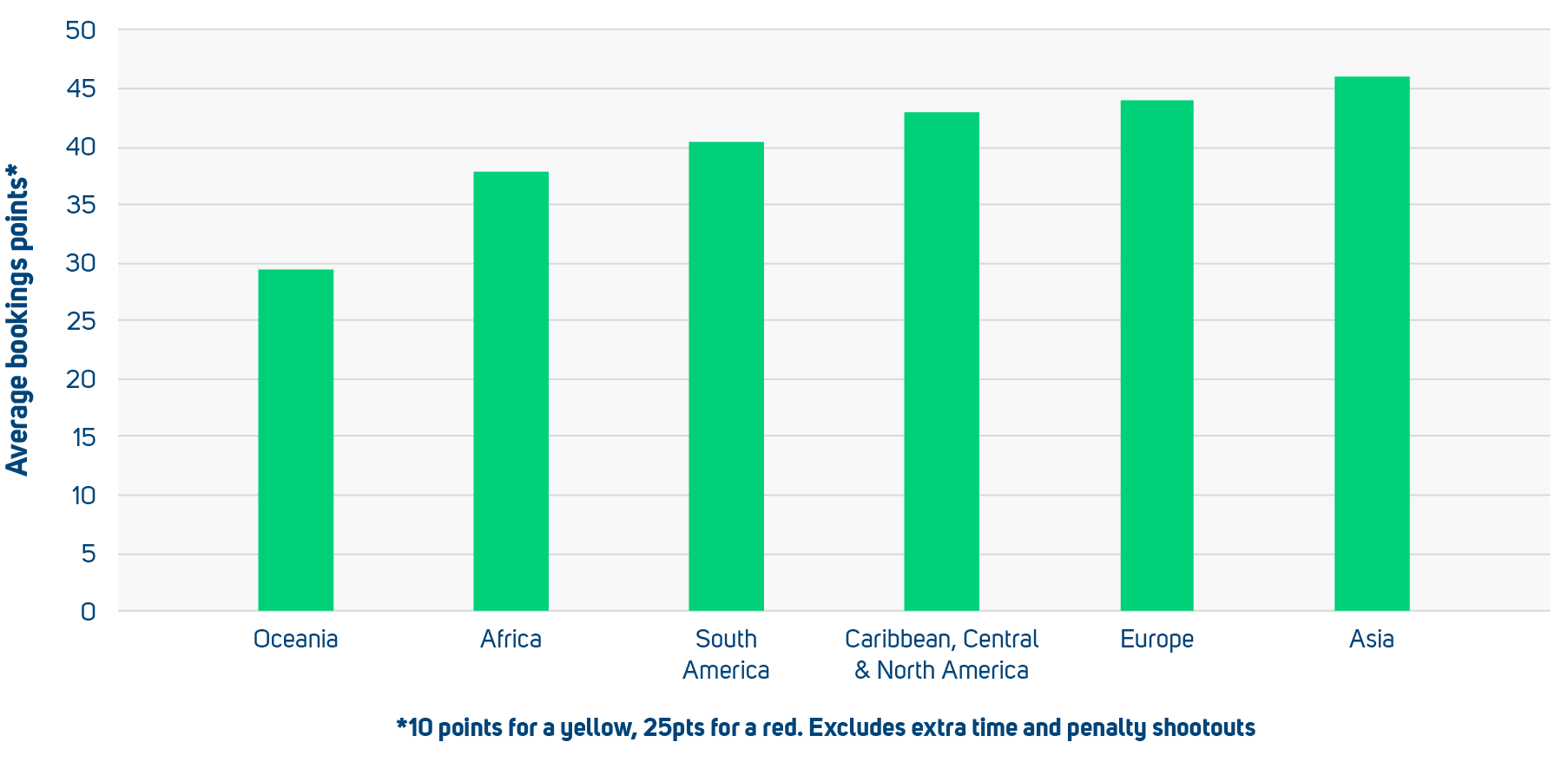
At the seven WCs between 1998 and 2022 referees averaged 42 bookings points per game. There was not much variation between those from most of FIFAs regional confederations. The average was 38 for Africa, 40 for South America, 43 for the Caribbean, Central America and North America, 44 for Europe and 46 for Asia. Officials from Oceania – islands in the Pacific – averaged only 29 bookings points per game, but they averaged only one game per tournament. It is a tiny and possibly unreliable sample.
Referees have different versions of themselves. Do not expect them to do at a WC what they have done outside a WC. You will not see that version of them. You will see the FIFA version.
Referees from different regions: average bookings points at WCs 1998 - 2022
The lesson for sportsbooks
A sportsbook trading any event in any sport, from the highest to the lowest profile, will want to know what influences outcomes and what does not. Our 10star partners benefit from models that take into account everything they should and nothing they should not. In addition, our automated risk management systems ensure liabilities are accepted according to a business’s own choices, while our unique customer sharpness algorithms respond in real time to every new wager as prompted by individual betting histories. On anything from a local friendly to a global championship.
Published 19 May 2026
For all enquiries contact info@10star.com